

Many people believe that the pro player salary He's always a millionaire. But the reality of esports is far more complex than the championship highlights that go viral on social media. In esports, money rarely works the way it seems online.
Because income almost never comes solely from gameplay. Salary, prize money, streaming, sponsorships, content, and community usually go hand in hand. And there's an important detail here: playing well helps, but building a sustainable financial career within the gaming industry requires much more than competitive performance.
How much does a pro player earn?
A pro player's salary varies depending on the game, organization, competitive level, and visibility. In Brazil, beginner players typically earn between R$ 1 thousand and R$ 5 thousand monthly in smaller teams or semi-professional settings. Athletes from tier 1 organizations, however, can surpass... R$ 40 thousand per month in more structured games like LoL, Valorant, and CS.
In the international arena, the difference grows even wider. According to Esports Earnings data, some professional players have already surpassed US$ has accumulated 7 million in official prize money., demonstrating how esports has transformed into a global economic ecosystem.
Pro player salary by level
| Level | Average salary range | How does income work? | Career reality |
|---|---|---|---|
| Beginner | Between R$ 1 mil and R$ 5 mil | It typically depends on small tournaments, financial aid, streaming, and side projects. | Unstable routine, lack of structure, and the need to balance training with studying or working. |
| Semi-pro | Between R$ 5 thousand and R$ 15 thousand | Some organizations already offer a fixed salary, competitive support, and content opportunities. | Greater stability and presence are beginning to emerge in the market. |
| Professional | It can exceed R$ 40 thousand monthly | Competitive salary combined with advertising, bonuses, and content creation. | Increased pressure for performance, public image, and consistent results. |
| Elite | Can it overcome? R$ 5 million per year combining multiple sources | Hybrid income involving contracts, sponsorships, streaming, campaigns, and international awards. | Visibility becomes a financial asset, and career begins to function as a personal brand. |
Beginner
At the beginning of their careers, the financial reality is often very different from the glamorous image that many people associate with esports. Beginner female players typically earn between R$ 1 thousand and R$ 5 thousand monthly, when they have some structural support.
In small teams and tier 3 scenarios, income often still depends more on amateur tournaments, content creation, and community support than on structured contracts.
And this creates enormous pressure. Because in addition to training, many people also need to juggle studying, working, and a competitive routine all at the same time. This scenario demands intense dedication. even before ensuring financial stability.
Semi-pro
At the semi-professional level, income starts to become more predictable. Some organizations already offer a fixed salary, structural support, and participation in larger championships.
At this stage, many players start earning between R$ 5 thousand and R$ 15 thousand monthlydepending on the type of sport, the organization, and the competitive relevance.
It is also at this moment that many people realize an important change: relying solely on competitive play can limit financial growth. Therefore, many female gamers begin investing in streaming, social media, and content creation alongside their training.
The logic of esports changes rapidly: vVisibility is starting to matter as much as competitive results..
Professional
In established professional settings, contracts typically include a monthly salary, a competitive structure, brand support, and participation in larger awards.
In games like LoL, Valorant, and CS, tier 1 players can surpass R$ 40 thousand monthly in more structured organizations — especially when they combine competitive salaries with campaigns, content, and sponsorships.
Second data from Riot GamesInternational leagues like League of Legends and Valorant attract millions of dollars in investments in rights, franchises, sponsors, and the competitive ecosystem.
At the same time, the The toll increases at the same rate.Performance, consistency, public image, and community relations directly impact opportunities and continued presence in the market.
Elite
In the elite of esports, income typically doesn't depend solely on competitive salaries. High-level pro players often combine multiple revenue streams: larger contracts, sponsorships, advertising campaigns, streaming, event participation, and content creation.
Node international scenariosome athletes easily overtake R$ 5 million per year adding up salary, prize money, and advertising revenue. In games like Dota 2, legendary players have already accumulated more than... US$ 7 million in official prize money throughout my career.
And there's an important difference here: at the top of the spectrum, visibility translates into a financial asset. Players who manage to build a strong community and digital relevance tend to greatly expand their monetization possibilities throughout their careers.
Where does the money in esports come from?
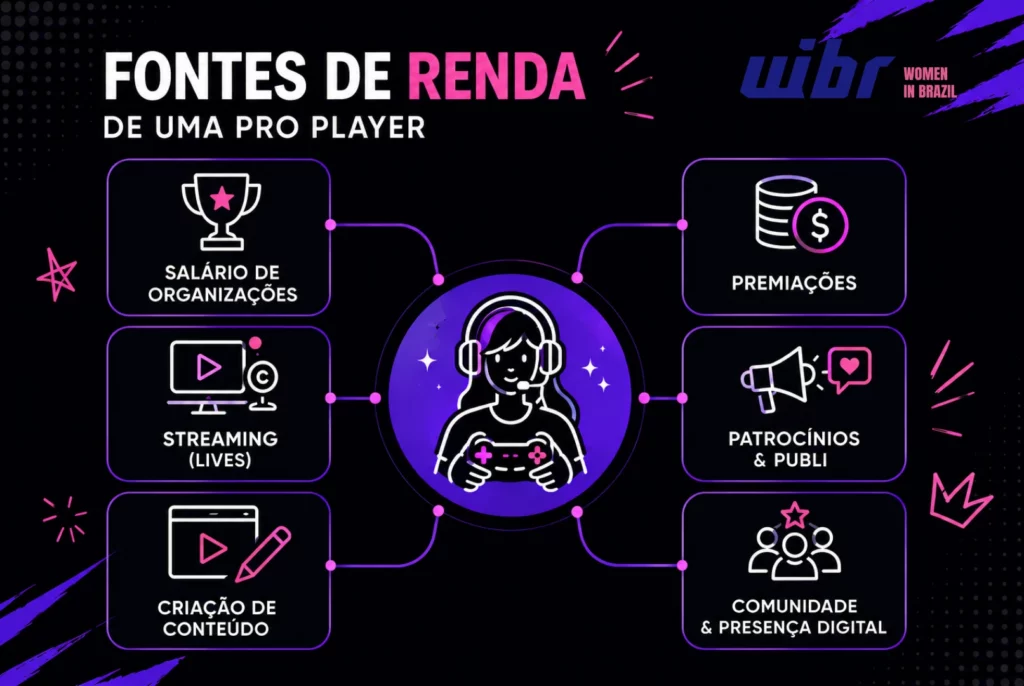
Many people imagine that pro players earn money only through tournaments. But the financial reality of esports works in a much broader way. Today, income typically combines a fixed salary, image, community, and digital presence.
The main sources of income are:
- Organizational salaries: Professional teams pay monthly salaries to athletes to represent the organization in championships, events, and brand activities;
- Awards: Championships distribute prize money that varies considerably depending on the game, tournament, and placement. VALORANT Champions 2025 distributed approximately US$ 2.25 million in total prize money;
- Streaming: Streaming on Twitch and YouTube helps gamers monetize their audience through subscribers, ads, donations, and partnerships;
- Sponsorships: Brands invest in pro players who have visibility, influence, and a strong connection with the gaming community;
- Content creation: Videos, social media, campaigns, and sponsored content have become an important part of revenue generation within esports.
And this completely changes the logic of a competitive career. Because today, in esports, building a community can be just as important as winning championships.
How much does a pro player earn per game?
LoL
Node league of legendsSalaries in Brazil typically vary considerably between academy, tier 2, and major league levels. Academy athletes usually receive lower salaries, while tier 1 players can earn more than tier 1 players. tens of thousands of reais per month in structured organizations.
Beyond competition, many athletes supplement their income through streaming, advertising, and digital presence. international leaguesElite players can sign multi-million dollar contracts throughout their careers.
Valorant
Valorant It has grown very rapidly in recent years and has become one of the most competitive esports scenes. Organizations have started investing heavily in lineups, infrastructure, and competitive branding.
VALORANT Champions 2025 distributed approximately US$ 2.25 million in prizes, while the inclusive scenario of Game Changers continues to expand investment and visibility in women's competitive gaming.
Beyond the competitive aspect, the game also encourages content creation, which expands monetization possibilities for female players who manage to build a strong digital presence.
CS
Counter-Strike It remains one of the largest financial ecosystems in esports, especially internationally. Major teams operate with high salaries, multi-million dollar prizes, and robust contracts.
Second Esports Earnings data, some historic CS players have already surpassed US$ 2 million in accumulated prizes throughout my career.
At the same time, the scene is extremely competitive. The financial difference between tier 1 and tier 2 is still very large, which creates a very unequal reality within the game.
free fire
O free fire It helped democratize access to esports in Brazil, mainly due to the strength of mobile gaming. This greatly expanded the entry of new talent into the competitive scene—including content creators and players who started out competing as amateurs.
Organizations such as LOUD It is Flow They helped transform Free Fire into one of the most relevant mobile ecosystems in the country, expanding opportunities for athletes, streamers, and creators.
O Free Fire World Series 2025For example, it has a total prize pool of approximately US$ 1 millionThis reinforces how mobile has also become a relevant financial ecosystem within esports.
Beyond the championships, the game has a strong connection with content creation and community, allowing many players to build a hybrid income through live streams, social media, and brand partnerships.
Why do salaries vary so much?
In esports, Salary never depends on a single factor.The value varies depending on the game, region, organization, competitive level, audience, and ability to generate visibility.
More popular games with larger ecosystems typically generate more money. Regions like North America, South Korea, and China also have significantly higher investments than the Brazilian scene in various game genres.
Furthermore, there's a point that many people ignore: public relevance directly influences financial opportunities. Players who manage to build a strong community tend to attract more brands, campaigns, and monetization outside of competitive play.
Performance matters. But so does visibility.
How is income evolving in esports?
At the beginning of their careers, income is often unstable. Many players depend on smaller tournaments, limited support, and sporadic opportunities as they try to survive. gain competitive advantage.
As one's career progresses, stability begins to appear through better contracts, entry into larger organizations, and... building your own audienceIt is at this stage that many people realize that professional positioning makes a real financial difference within esports.
At the top of the spectrum, the logic changes completely. Income no longer depends solely on competitive play and begins to function in a hybrid way. Salary, sponsorship, advertising, streaming, events, and content start working together.
And that's precisely why the The esports elite rarely builds income from a single source..
How much does a pro player earn in Brazil?
O Salary of a pro player in Brazil It varies considerably depending on the sport, organization, and competitive level. Beginner players still face significant financial instability, while more structured teams offer fixed salaries, technical support, and more solid contracts.
In more established sports, tier 1 athletes are able to surpass R$ 40 thousand monthlyespecially when they combine competitive salary, advertising campaigns, and content creation.
According to Game Brazil Research 2025Women represent 53.21% of the Brazilian gaming audience, reinforcing how female presence is no longer an exception within the industry.
When compared to international markets, however, the Brazilian scene still generates less money than leagues in North America, Europe, and Asia. This directly impacts salaries, prize money, and organizational investment.
At the same time, the Brazil has one of the most engaged gaming communities. of the world. And this strengthens opportunities in streaming, digital influence, and personal brand building — especially for those who can combine competitiveness with an online presence.
A career beyond the salary.
There is a very limited view on careers in esports When everything revolved solely around a competitive salary. Because the reality of the industry has changed. Today, growing financially in the gaming scene increasingly depends on building a presence, community, and positioning.
The main pillars of this evolution are:
- Hybrid income: Combining competitiveness, content, advertising, and community reduces financial dependence on a single source;
- Personal branding: Players who build a strong brand identity tend to expand their opportunities both on and off the field.
- Content creation: Social media, live streams, and videos help athletes monetize their audience even outside of the competitive calendar.
And that explains why so many careers continue to grow even after leaving the professional scene. In esports, influence and community have real economic value.
Check out this conversation about careers for women in the gaming world:
Financial challenges of esports
Despite the growth of the industry, the Esports still faces financial challenges. Important. Instability, high competitiveness, and short careers are part of the reality for many people in the competitive landscape.
Furthermore, there is constant pressure for performance, audience reach, and digital relevance. And this can lead to emotional and financial burnout over time.
The most common mistakes are:
- Ignore visibility: Many gamers focus solely on competitive play and fail to build a relevant digital presence;
- Not diversifying income: Relying solely on a competitive salary increases financial vulnerability;
- Thinking that simply playing well is enough: Performance without positioning is unlikely to sustain long-term growth;
- Incompatible lifestyle: Rapid growth without financial planning can lead to instability, even during successful career phases.
- Dependence on a single platform: Building an audience solely on one network increases the risk of losing reach and monetization.
Therefore, more and more esports professionals are treating their competitive careers as brand building—and not just as a championship outcome.
How can you increase your income?
Financial growth in esports depends on much more than mechanical skill. Today, positioning, networking, and community are key factors. directly influence opportunities that appear within the gaming industry.
Female players who manage to build a consistent presence, actively participate in the community, and create strategic connections tend to expand their reach much more. career monetization possibilitiesAnd this applies to both competitive play and content creation.
It is precisely at this point that initiatives such as WIBR They make a difference. Because in addition to strengthening female representation, communities like these help women create visibility, networking, and real opportunities within the gaming scene.
Want to turn networking into real opportunities within the gaming industry? WIBR Talent Wall It connects professionals, creators, and organizations in the gaming scene for job openings, projects, and opportunities within the gaming ecosystem.
Ultimately, it's not just about how much you earn. It's about how you build that income..
FAQ
Beginner players earn between R$ 1,000 and R$ 5,000. In tier 1 teams, salaries can exceed R$ 40,000 per month.
Yes. In addition to a competitive salary, many athletes earn money through streaming, advertising, sponsorships, and content creation.
In LoL, tier 1 players can earn tens of thousands of reais per month in well-structured organizations.
Yes, especially when the revenue combines competitiveness, content, advertising, and community.
The main sources include championships, streaming, sponsorships, social media, and advertising campaigns.
In smaller teams, salaries start between R$ 1,000 and R$ 5,000. In tier 1 organizations, salaries can exceed R$ 40,000.
Building a digital presence, strengthening networking, and diversifying income accelerate financial growth within esports.





 English
  Português do Brasil